
If you’re looking for a fish that’s as vibrant as it is peaceful, the German Blue Ram might just be the centerpiece your aquarium needs. Known for its electric blue shimmer and gentle temperament, this stunning dwarf cichlid brings both color and character to any freshwater tank.
Scientifically named Mikrogeophagus ramirezi, the German Blue Ram hails from the warm, slow-moving waters of the Orinoco River basin in South America. Over the years, it has become a favorite among aquarists for its graceful movement, intelligent behavior, and fascinating breeding rituals.
But don’t let its beauty fool you—it’s not your average beginner fish. The German Blue Ram requires stable water parameters, a well-maintained tank, and a bit of experience to truly thrive. In this guide, we’ll walk you through everything from tank setup to feeding, breeding, and troubleshooting so you can confidently care for your German Blue Ram.

Origins and Appearance
The German Blue Ram, scientifically known as Mikrogeophagus ramirezi, is native to the Orinoco River Basin, which stretches across Venezuela and Colombia. These slow-moving, plant-rich waters create the perfect conditions for this species to evolve into one of the most striking freshwater fish available to hobbyists today.
Unlike many other dwarf cichlids, the German Blue Ram is celebrated for its calm demeanor and compact size—usually reaching just 2 to 2.5 inches in adulthood. Its shimmering body displays a brilliant mix of neon blue, gold, and iridescent green, with a black vertical stripe running through its eye and a subtle purple hue across its belly. Males tend to be slightly larger with elongated dorsal fin extensions, while females can be identified by a rosy pink patch on their underside.
Selective breeding has also led to vibrant variations like the Electric Blue Ram, which features even more intense coloring. Despite these enhancements, all types of German Blue Rams maintain the same care requirements and gentle nature, making them ideal for peaceful community tanks.
Their captivating appearance and rich origin story are part of what makes them a prized addition to any aquascape.
German Blue Ram Tank Setup & Water Parameters
Creating the right environment is key to the health and happiness of your German Blue Ram. Unlike hardy beginner fish, this species is sensitive to water changes and requires a well-maintained setup that mimics its natural habitat.
Let’s start with tank size. A single pair of German Blue Rams should have at least a 20-gallon aquarium. While they’re small in size, they are territorial, especially during breeding, and need room to explore without stress. If you plan on keeping more than one pair or adding tank mates, go larger to maintain peace.
Water parameters are critical. Your German Blue Ram thrives in soft, slightly acidic water with a pH level between 5.0 and 7.0. The ideal temperature range is 78°F to 86°F, with most breeders preferring the higher end of that range, around 82°F. Invest in a reliable aquarium heater to maintain this consistency.
Water hardness should be kept low—ideally under 12 dGH. Rams are incredibly sensitive to sudden shifts, so always acclimate them slowly when moving tanks or doing water changes.
In terms of decor and substrate, aim for a planted tank setup. Live plants not only provide hiding spaces but also help stabilize water chemistry. Use sand or fine gravel as the substrate to replicate the soft riverbeds of the Orinoco Basin. Add driftwood, flat rocks, and gentle lighting to complete the natural look.
Strong currents are a no-go for this peaceful species. Use a sponge filter or an adjustable flow filter that won’t stress your fish. Also, make sure to cycle the tank fully before adding any German Blue Rams—they don’t tolerate ammonia or nitrite spikes.
When set up right, a German Blue Ram tank becomes more than just a display—it’s a living, thriving habitat that brings out the best in their color, behavior, and health.
Water Quality & Maintenance
If there’s one thing every German Blue Ram owner learns early, it’s that water quality isn’t optional—it’s essential. These fish are notoriously sensitive to poor conditions, and even slight imbalances can lead to stress, illness, or early death.
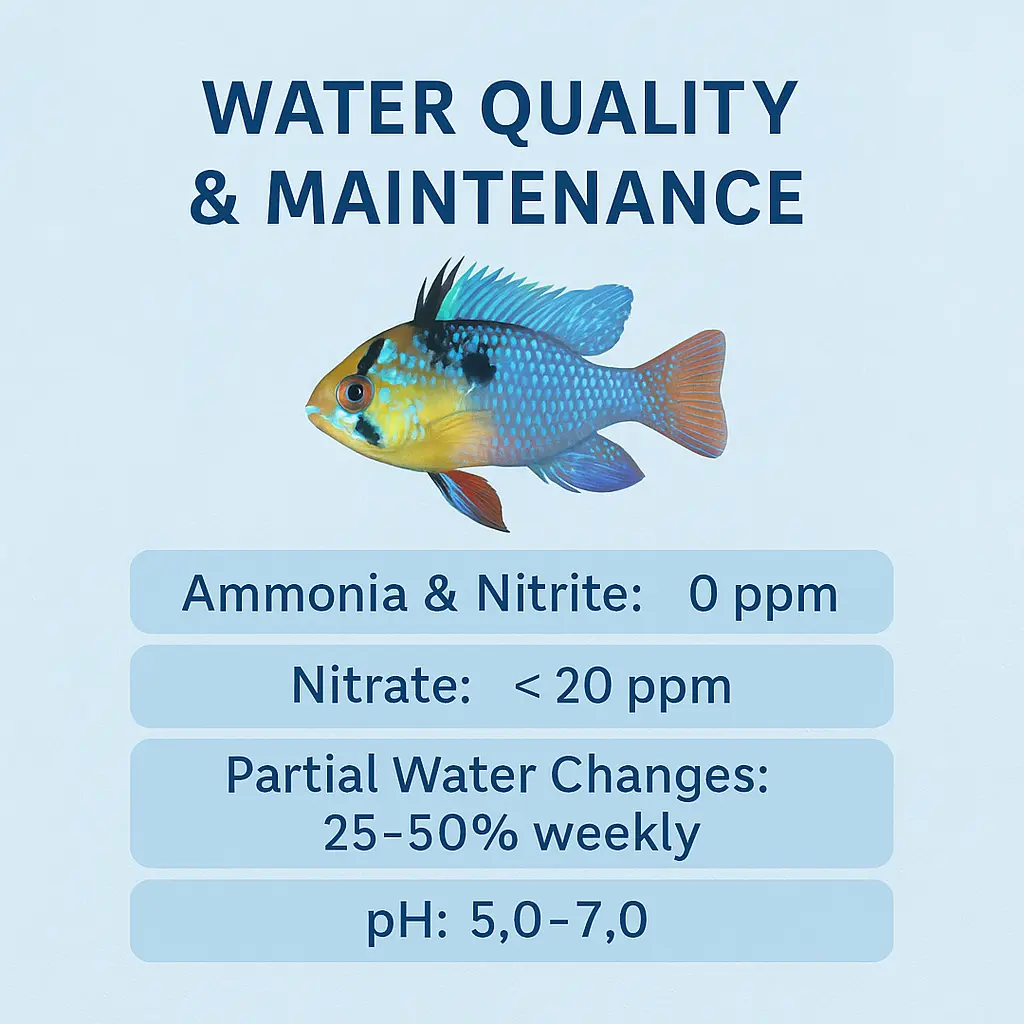
Start with the basics: ammonia and nitrite levels must stay at 0 ppm—always. Even trace amounts can severely affect your German Blue Ram’s health. Nitrate levels should be kept under 20 ppm, and ideally closer to 10 ppm, especially if you’re planning to breed them.
The best way to keep water parameters stable is through consistent aquarium maintenance. Perform a partial water change of 25–50% every week. Make sure the replacement water is treated, temperature-matched, and pH-balanced. Abrupt changes in water chemistry can shock your German Blue Rams, who prefer stability above all.
Invest in a good test kit and monitor your tank weekly—not just during emergencies. Keep an eye on pH, GH/KH, and temperature, particularly if you live in an area with fluctuating tap water quality.
Many aquarists use sponge filters or gentle filtration systems to avoid disturbing the peaceful nature of these fish. Pair this with live plants, which help absorb excess nitrates and offer natural biological filtration.
Lastly, patience pays off. Always allow your tank to fully cycle before introducing your German Blue Rams. A mature, well-maintained aquarium isn’t just recommended—it’s non-negotiable for long-term success.
German Blue Ram Feeding & Diet
When it comes to feeding, the German Blue Ram isn’t overly picky—but it does require a balanced, high-quality diet to stay vibrant and healthy. As an omnivorous species, this fish thrives on variety. In the wild, it forages for small invertebrates, insect larvae, and plant matter. You’ll want to replicate this diverse intake in your aquarium.
The foundation of a proper German Blue Ram diet should include high-protein pellets or flakes made for cichlids. Look for slow-sinking varieties, as rams often feed mid-water or near the substrate. Supplement this with live or frozen foods a few times a week, such as brine shrimp, bloodworms, daphnia, or mosquito larvae. These treats help enhance color, support breeding, and satisfy the fish’s natural hunting instincts.
Feed your German Blue Ram in small portions twice a day. They have relatively small stomachs, and uneaten food can quickly degrade water quality—a major concern with such a sensitive species.
Consistency is key. Feed at the same time each day to build routine and reduce anxiety, especially in tanks with multiple fish. If your rams aren’t eating well, check water parameters—they often stop eating when stressed or if something’s off.
Lastly, always remove uneaten food after 5–10 minutes. This not only keeps your tank clean but prevents ammonia spikes that could harm your fish.
In short, a balanced German Blue Ram feeding schedule isn’t just about nutrition—it’s part of your overall care system for a thriving, colorful aquarium.
Behavior & Compatible Tank Mates
One of the reasons aquarists fall in love with the German Blue Ram is its unique personality. These fish are generally peaceful, intelligent, and interactive—but also a bit shy and easily stressed, especially in high-traffic or aggressive tanks.
Unlike many other dwarf cichlids, the German Blue Ram doesn’t exhibit dominant or overly territorial behavior unless it’s breeding. Even then, its aggression is short-lived and mostly limited to guarding eggs or fry. That makes it an excellent candidate for peaceful community tanks, provided the environment stays calm and well-maintained.
Ideal tank mates include similarly non-aggressive species like neon tetras, ember tetras, corydoras catfish, kuhli loaches, and otocinclus. These species share similar water parameters and won’t outcompete your rams for food.
Avoid placing German Blue Rams with fin-nippers or fast, boisterous swimmers like tiger barbs or larger cichlids. Their timid nature means they often get outcompeted or bullied in aggressive setups, leading to hiding, stress, or illness.
Keep in mind that the German Blue Ram thrives in smaller groups or as bonded pairs. If housing more than one pair, ensure ample space and visual barriers like plants and rocks to prevent tension.
With the right companions, your German Blue Ram will become more confident, display vibrant colors, and interact more openly—adding both beauty and balance to your aquascape.
Breeding German Blue Rams
Breeding the German Blue Ram can be one of the most rewarding experiences for a hobbyist—but it’s not without its challenges. These fish are considered moderately difficult to breed, mainly because they require very specific conditions and stable water chemistry.
To begin, ensure you have a compatible breeding pair. Rams form monogamous bonds, so it’s best to purchase a small group of juveniles and allow natural pairs to form. Once bonded, a couple will often stake out a territory and begin courting behavior.
Set the water temperature to around 82–86°F, which mimics their breeding season in the wild. Keep the pH between 5.5 and 6.5, and ensure the water is soft and very clean. Frequent partial water changes and minimal fluctuations are crucial for breeding success.
Provide flat rocks, smooth driftwood, or broad plant leaves where the female can lay her eggs. The German Blue Ram is a substrate spawner, and a flat surface gives them a safe spot to place up to 300 eggs at a time.
Once the eggs are laid, both parents typically guard them—fanning the eggs to keep them oxygenated and free from fungus. If you’re lucky, you’ll witness excellent parental care, though first-time parents may eat their eggs if stressed.
After hatching (in about 48–72 hours), the fry become free-swimming within 5 days. At this stage, feed them infusoria, followed by baby brine shrimp as they grow.
Consistency and patience are your best tools when breeding German Blue Rams. While it may take a few tries, the sight of a pair nurturing their young is truly unforgettable.

Common Health Issues & Troubleshooting
Despite their beauty, German Blue Rams are not the hardiest fish. Their sensitivity to water conditions makes them more prone to stress and illness than many other freshwater species. Fortunately, with close observation and proactive care, most health issues can be avoided or treated early.
The most common problems include Ich (white spot disease), fin rot, and bacterial infections, often triggered by sudden changes in water parameters or temperature drops. Since the German Blue Ram is highly sensitive, even brief exposure to poor conditions can lead to rapid decline.
To prevent health issues:
- Maintain strict control of ammonia, nitrites (0 ppm), and nitrates (<20 ppm)
- Keep temperature stable (78–86°F) with no sudden dips
- Perform regular water tests and partial water changes
- Quarantine new fish before introducing them to your main tank
If your German Blue Ram is hiding excessively, refusing food, or showing dull colors, it’s often a sign of stress. Double-check your water quality and tank dynamics—are there aggressive tank mates? Has the pH shifted?
When treated promptly and in a stress-free tank, most health concerns are reversible. Remember: a calm, stable environment is your best defense against illness in German Blue Rams.
FAQs About German Blue Rams
Q1: What is the average lifespan of a German Blue Ram?
A healthy German Blue Ram typically lives between 2 to 4 years. Their lifespan can be extended with stable water conditions, proper diet, and minimal stress.
Q2: Can German Blue Rams live in a community tank?
Yes! They thrive in peaceful community tanks with non-aggressive species like tetras, corydoras, or otos. Avoid housing them with larger or fin-nipping fish.
Q3: How do I tell male and female German Blue Rams apart?
Males are slightly larger, with more pointed dorsal fins. Females often display a pinkish belly and a more rounded body.
Q4: What pH level is best for German Blue Rams?
They prefer slightly acidic water, with a pH between 5.0 and 7.0. Consistency is more important than perfection—avoid sudden swings.
Q5: Are German Blue Rams good for beginners?
They’re not ideal for first-timers. German Blue Rams are sensitive fish that need precise water parameters and care. That said, committed hobbyists with some experience can absolutely succeed.
Q6: Do German Blue Rams eat shrimp?
Larger species like Amano shrimp are usually safe. Smaller shrimp, like cherry shrimp, may become a snack—especially during breeding season.
https://shorturl.fm/9EFI3
https://shorturl.fm/6XoUI
https://shorturl.fm/XBpiV
https://shorturl.fm/tlwn6
https://shorturl.fm/rPEx7
https://shorturl.fm/q4vQM
https://shorturl.fm/0sHKY
https://shorturl.fm/1A5Pu
https://shorturl.fm/o7ap2
https://shorturl.fm/Osy3U
https://shorturl.fm/PRf1v
https://shorturl.fm/gu6yo
https://shorturl.fm/HrkuR
https://shorturl.fm/AvZ42
https://shorturl.fm/vJauJ
https://shorturl.fm/yfyQM